
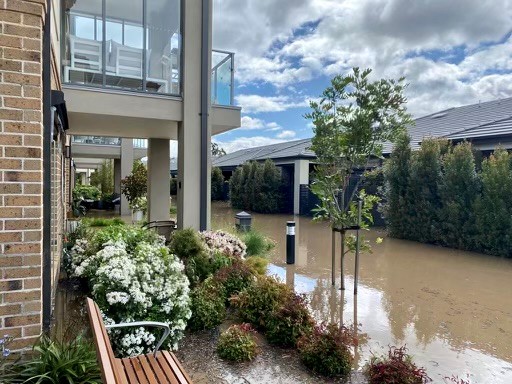
An investigation report by the Victorian Ombudsman has found “rushed and flawed” flood modelling and building plan mistakes by Melbourne Water, caused major flooding at a retirement housing estate near the Maribyrnong River in 2022.
Tabled in Parliament today by Ombudsman, Marlo Baragwanath, the ‘When the water rises’ investigation focused on two sites – Rivervue Retirement Village, which was significantly affected by the 2022 Maribyrnong river flood; and the Kensington Banks residential estate, which modelling has shown is at risk of future flooding.
The investigation found that different issues affected residents in each development. At Rivervue – where 45 homes were left significantly damaged by floodwaters – the investigation found that Melbourne Water’s rushed and flawed flood modelling, coupled with building plan mistakes, caused the flooding at the site in 2022 and has resulted in vulnerable retirees living in a known flood hazard area.
“These mistakes – made in the early 2000s – were recognisable and avoidable,” said Ms Baragwanath.
For Kensington Banks, the investigation found that multiple factors – including climate change impacts, lags in updates to flood modelling and a sinking flood protection levee – appear to be contributing to the development’s new flood risk status, rather than the kind of mistakes that played out at Rivervue. The investigation found that residents could have confidence in the latest Maribyrnong catchment model.
“It’s vital that the community can access accurate, up-to-date information about flood modelling in their area, to inform their decisions,” said Ms Baragwanath.
“The experiences of residents at Rivervue and Kensington Banks highlight the need for high-quality flood risk information to be available to the community and incorporated into the planning scheme.”
The investigation also involved assessing flood modelling for the Maribyrnong catchment and considering the need for related policy reforms and compensation for affected residents.
“Climate change is an urgent priority, and we need to start preparing for the likely impacts on the places we live, work, study and play,” Ms Baragwanath said.
While most of the report’s 13 recommendations – calling for better flood risk planning, factoring climate change into decisions, and helping the community to make informed decisions – have been accepted, Ms Baragwanath said the Victorian Government is yet to accept two important recommendations focused on compensation for flood-affected residents and establishing a resilience program.
“The flooding of Rivervue homes stems from failures by the State. Residents, through no fault of their own, are now left significantly out-of-pocket and forced to spend their retirement in a flood-prone area. While compensation is not something we recommend lightly, in this case, it is the fair thing to do,” said Ms Baragwanath.
“Having set out the evidence, I hope the Victorian Government accepts our recommendations for support for people impacted by flood risks.”
In Recommendation 11, the Ombudsman called on Melbourne Water, in collaboration with the City of Melbourne Council to investigate the height of the Kensington Banks flood protection levee, and: a. consider, as part of the Maribyrnong River Catchment Flood Mitigation Study, whether flood risk can be mitigated by repairs or improvements to the levee; and b. consider whether relevant inputs to the 2024 flood model should be updated. This recommendation was accepted by Melbourne Water and supported by City of Melbourne Council.
In Recommendation 12, Ms Baragwanath said the Government, in collaboration with Melbourne Water and the City of Melbourne, should prepare and deliver a pilot information package for Kensington Banks residents impacted by reassessed flood risk. The information package should be launched within six months, she said.
The Department of Transport and Planning accepted the recommendation in principle; the Department of Energy, Environment and Climate Action supported in principle; while the City of Melbourne Council supported the recommendation.
Download the full report and a summary: ‘When the water rises: Flood risk at two housing estates’.
