

SPONSORED CONTENT
By Sean Wallace, VP Sales & Community, Flowingly.
Ask any council employee how they feel about documenting a process, whether that’s writing up the SOP or mapping a process, and you’ll get the same reaction: a sigh, or a “where will I find the time for that?”
Nobody joined local government to spend their afternoon formatting a Word document about how they submit an invoice. And yet we keep asking them to.
Pull people into a workshop, ask them to describe their job, screenshot it, format it, draw the boxes and arrows. It’s slow, it’s last on a to-do list that never gets any shorter, and after all this it gets dumped in a digital filing cabinet somewhere to gather dust. By the time the next person opens it, the process has changed yet again.
This isn’t a discipline problem. Councils aren’t short on people who care about doing things properly. If anything, local government has more process-minded people per capita than most industries.
The way we’ve always captured process knowledge was built for a slower era, one where transformation happened once a decade through a big programme, not continuously through ERP transitions, AI pilots and service reviews landing on top of each other. And our process tooling cannot keep up.

Documenting asks people to remember. Capturing lets them show you.
Think about how most process documentation actually happens, when it happens at all. Someone sits down and tries to reconstruct the process from memory, in Word or Miro or with a BA helping them with sticky notes. Not only does this drain time, it’s open to interpretation and forgetfulness. And that’s best case – more often nobody gets around to it and the process only exists in someone’s head.
Some processes genuinely need a group working through the detail together – identifying improvements as they go. But to do this across every critical process in the organisation you’d need an army of BAs to do it, let alone maintain it.
So you end up with process work becoming a one-off project full of what people remember doing, rather than what they actually do.
There’s a better model. Instead of asking someone to describe the job from memory, let them capture it in whatever way makes sense for the work – whether that’s a screen recording, their voice, a whiteboard or something else entirely.
Let’s take screen recording as an example. A staff member hits record and carries on with the job. AI captures what they do and turns it into something useful: an SOP, a process map or even a workflow. Instead of documenting the same process three different ways, you’ve captured it once and can use that knowledge again.
That’s exactly what Flowingly does.
Capture the work as it happens and you get an accurate record, without ever pulling anyone away from their day to produce it.
The proof is already sitting in your process library
When Hurunui District Council moved off its old platform, 62% of its process library got retired along the way, because nobody had opened those processes in years – the kind of shelf life that’s hard to avoid when documentation is something you do once and hope holds up.
Maribyrnong City Council took a different route. Instead of asking staff to write processes up after the fact, they let people capture their knowledge as part of the job itself. As Business Process Analyst Mardi Hirst put it:
“Staff are able to capture their knowledge and record processes as part of their normal work, without taking additional time out of their day.”
The difference came from cutting out the part everyone dreaded in the first place – and it shows: Maribyrnong cut the time staff spent on documentation by up to 80%.
Capture once, use it everywhere
The other thing that’s changed is what you can do with process knowledge once you’ve captured it properly. The old model treated a written SOP, a visual process map and an automated workflow as three separate projects, usually owned by three different people, often built in three different tools that don’t talk to each other.
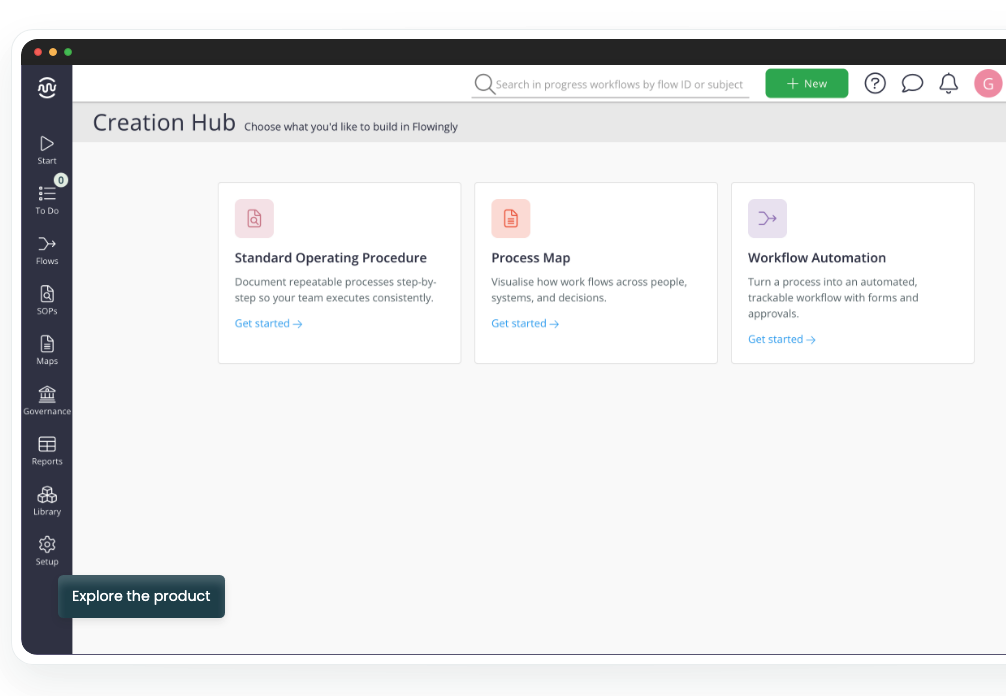
If you capture a process accurately once, there’s no reason it should need rebuilding for every use case. The same process knowledge can become the step-by-step user guide a new starter follows, the end-to-end map a BA uses to spot the bottleneck, or the workflow that automates the work itself.
Capture it. Use it in multiple ways. And when the process changes, update the knowledge rather than starting from scratch.
That matters more than it might sound, because councils don’t get the luxury of a quiet year to catch up on documentation. ERP transitions, AI pilots and service reviews are landing on top of each other now, not one at a time. Every one of them starts with the same question: how does this actually work today?
If that knowledge is already captured, governed and current, improvement projects don’t need to begin with another discovery project.
And every one of our improvement projects will be faster and more fit for purpose when the current state comes from a live record instead of a workshop and someone’s memory.
Changing how the work gets captured, not just who does it
None of this is about replacing the people who do process work in councils: the BAs, the change teams, the improvement leads. It’s about giving them a starting point that’s already accurate, so their time goes into the harder, more valuable work of actually improving how things run, instead of chasing down how things currently run in the first place.
And because that process knowledge is governed in one place, the SOP, map and workflow don’t have to become three disconnected versions of the truth.
Councils don’t need another six-month discovery project before they can start improving. They need a clearer picture of how work actually happens today – without pulling staff away from doing it.
Because nobody joined local government to spend their afternoon writing up how they submit an invoice – and increasingly, they don’t have to.
See it in action: Flowingly’s Introducing Creation Hub webinar walks through a real council process going from a screen recording to a finished SOP, process map and automated workflow in minutes – not weeks.
Flowingly is the governed AI process platform used by over 60 councils to capture how work really happens and turn that knowledge into SOPs, process maps and automated workflows. Capture once, use it in multiple ways, and keep it governed and current as the work changes.
