
Queensland’s City of Moreton Bay Council is preparing to pioneer new traffic signal technology as part of an Australian-first pilot of the AI-powered system.
The next generation (next-gen) traffic signal hardware runs on a ‘movement-based’ control system and manages individual movements without being tied to a pre-determined sequence or fixed grouping of traffic lights. The system is designed to reduce delays and wait times at signalised intersections.
Mayor, Peter Flannery said Council was proud to be pioneering what could be a gamechanger for motorists and pedestrians.
“We’re excited to be the first in Australia to trial technology that has the very real potential to improve the flow of traffic around our road network,” he said.
“The technology effectively uses both AI and advanced algorithms to inform optimised traffic operations under a new traffic management approach.
“This means that higher traffic flows of vehicles including public transport can be prioritised dynamically throughout the day.
“There is the potential to substantially reduce the time motorists spend unnecessarily sitting at red lights, which is often constrained by legacy traffic control methods, and this can be extremely frustrating especially when there are no cars in sight.
“This presents the opportunity to reduce emissions as vehicles will idle less at traffic lights.
“Plus, for the first time, traffic signals can be adjusted by individual movements using advanced traffic detection sensors so congestion can be better managed including when vehicles flood our local road network,” the Mayor said.
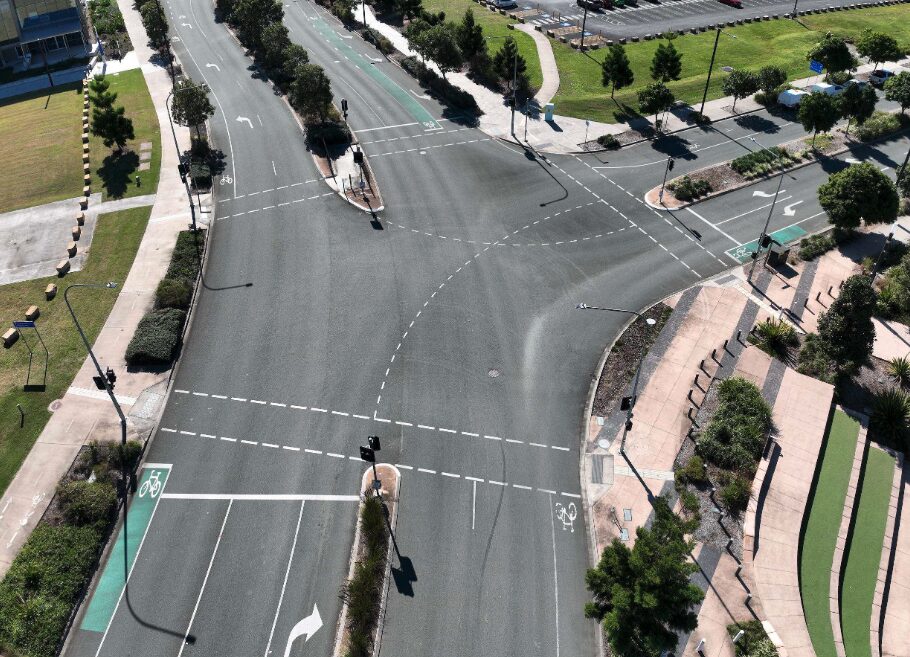
The new traffic technology is being tested at the intersection of Moreton Parade and Paper Avenue in Petrie (pictured) and will be implemented at the intersection later this year.
Installation of the technology involves replacing existing traffic signal controllers at intersections with next-gen traffic signal hardware. This hardware instantly makes decisions about the most optimal way to control traffic even with in-ground loop detectors which is the existing method of vehicle detection.
To support the system, Council will also install advanced vehicle detection sensor technology to collect high-quality traffic data that will support traffic optimisation by classifying road user types (cars, trucks, pedestrians, cyclists) and predict traffic flow.
If the pilot at Moreton Parade and Paper Avenue, Petrie proves successful, Council says it will then move to test the technology at a more complex intersection.
