

ARRC Gold Coast Chief Executive Officer, Grant Gabriel, has told the Solving Plastic Waste Cooperative Research Centre (CRC) conference that Australia should stop asking how to get rid of waste and start asking what it will become next.
Delivering the keynote address at the conference in Brisbane, Mr Gabriel said the materials, technology, regulation and community expectations shaping waste were all changing, and the industry’s thinking had to change with them.
He set out four ideas: change the way we see waste, find value where others see waste, innovate beyond convention, and turn ideas into action.
“If waste is seen as something to be managed, we build waste management systems,” Mr Gabriel explained.
“If it’s seen as a collection of materials, energy and resources, we build resource recovery systems.”
That philosophy underpins the ARRC precinct, the City of Gold Coast’s vehicle for an integrated resource recovery and energy precinct.
“Rather than one facility solving one problem, the ARRC precinct will be a connected system in which organics become products and nutrients, recyclables become manufacturing feedstock, residual materials become energy and minerals become alternative materials,” Mr Gabriel said.
“Anything left unsolved becomes the next research challenge, our vision is for the precinct to become a living laboratory.”
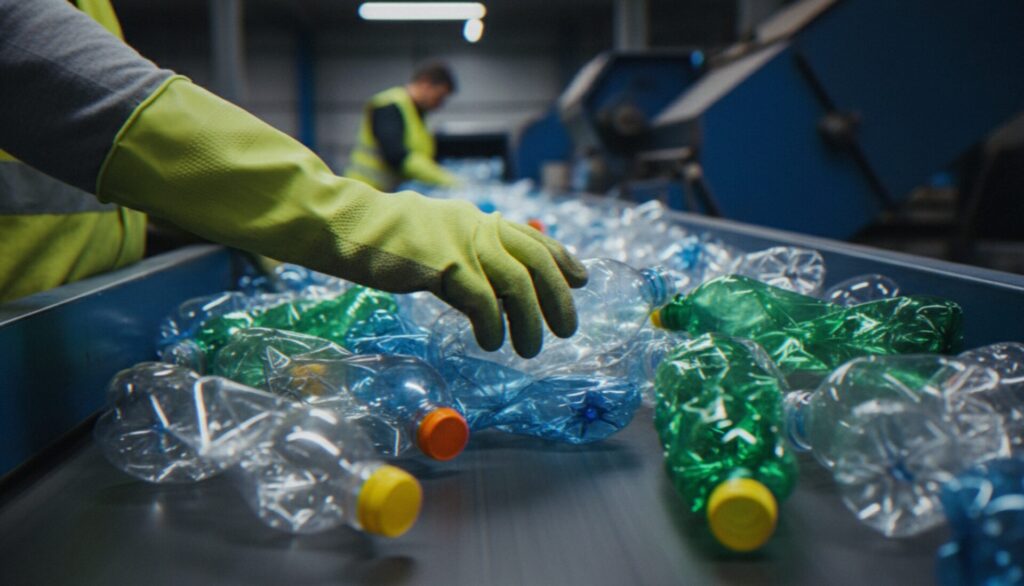
On plastics, he warned against treating a family of polymers, additives and multilayer formats as a single material.
“The right question is what the highest-value pathway for each material might be – reuse, mechanical recycling, advanced material recovery or, where nothing else stacks up, energy recovery – rather than simply whether it can be recycled,” he said.
“The sector has plenty of ideas but too few places to prove them at scale against real waste streams, real operating conditions and real commercial constraints. The planned ARRC Hub and ARRC Innovation facilities are designed to close that gap, giving researchers somewhere to test, industry somewhere to demonstrate and investors reason for confidence.”
Mr Gabriel praised the Solving Plastic Waste CRC for tackling plastics from a different direction and closed with a challenge to the room: ‘how much value can we capture before we call something waste?’
